Letting Go of Suffering: Week 1- The Beginning

You are probably reading this post because you have a desire to let go of your suffering. This course will consist of 17 lessons, each containing concepts or tools that can aid you in your endeavor. The content is based on a workbook I wrote in 1991. I will be posting a new lesson each Monday.

Suffering, as used in this course, is defined as “extended hurt.” It is “the persistence of painful feelings long after they were provoked.” (Judy Tatelbaum)  Letting go of suffering does not mean living a life void of challenges or pain; it means not getting stuck in the pain

People often think of suffering as being prolonged sadness. It can also be prolonged anger or fear. There is likely to be some degree of suffering present whenever we are holding on to the past or worrying about the future.

Suffering is also brought on by the unhealthy behaviors we do in the present, those behaviors that make us miserable.

Be gentle with yourself as you go through the course.  Let this be an opportunity for you to experience being successful without expecting yourself to be perfect.

During the first two weeks, you will be gathering information about yourself. You will also learn more about suffering and about letting go. As you complete the exercises, either print the post and write your answers directly on the exercise sheets, or just write your answers in a notebook.

Exercise 1

When you are suffering, it is often important to get help from others as you work to shift the energy. In the boxes below, or in your journal or notebook, write the names and phone numbers of people in your life who might be available when you need support.

support-2

Exercise 2

What scares you about letting go of your suffering? Write down any fears that come to your mind, whether they make sense to you or not.

fear2

Exercise 3

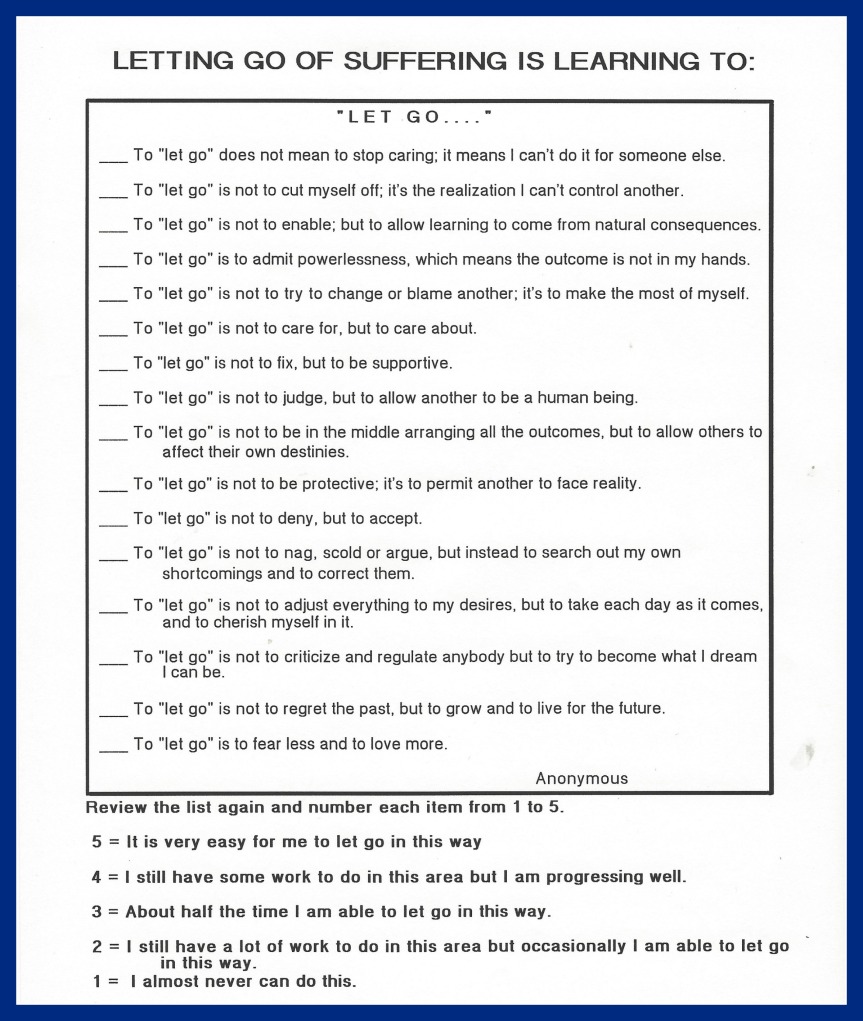
letgo2

For the rest of this week, reflect on your answers to these three exercises. Consider journaling about the thoughts, feelings and/or insights that surface as you do that.


See you next Monday for the second lesson.

To find the lessons in this series that have already been published click here.

Letting Go of Suffering- New Series Announcement

Are you tired of holding on to the past or worrying about the future?

Have you had your fill of feeling like a victim?

Are you committed to stopping your self-defeating behaviors?

Starting on Monday, November 21, I will be posting one chapter a week (for 17 weeks) from the Letting Go of Suffering workbook I wrote in 1991. If you answered “Yes” to any of the questions above, this upcoming “course” may be instrumental in helping you to make those changes.

This course is meant to increase your understanding of why you are the way you are and to teach you some new behaviors that can facilitate your movement from suffering to joy. Among the areas that will be addressed are:

  • Identifying Your Vision
  • Discovering Your Suffering Profile
  • Stopping Passive Behavior and Critical Self Talk
  • Using Affirmations and Contracts to Heal
  • Holding Yourself Accountable

I look forward to the possibility of sharing this journey with you.

Letting Go of Suffering Series:

Letting Go of Suffering- New Series Announcement

Letting Go of Suffering- Week 1: The Beginning

Borrowing Worry

upset-534103_1280


“In essentially all individual moments, we’re safe and physically comfortable. We generally have to borrow worry from the future or the past to maintain unhappiness.”

Fritz Reitz


Reclaiming the Right to Trust

hands-1201785_1280

I believe, at the core of every person, there is a part that is both trusting and trustworthy. Due to life’s traumas, however, that part may recede so deep inside that it may seem unreachable. In time, a person may even develop a belief system that says people are not to be trusted.

When people come from that framework, they are likely to see negativity, and even danger, coming from all sides. They don’t trust what others say, and look for ulterior motives. In time, they may become excessively independent. The thought of being interdependent may be unfathomable. The inability to trust often leads to anxiety and depression.

I have been a psychotherapist for almost 30 years. During those years, I have seen so many clients reclaim their right to trust. As they heal from the traumas of their past, they shift from the life stance that people are untrustworthy to an attitude that people are trustworthy unless proven otherwise.

That doesn’t mean that they start to trust without discrimination though. Once they work through their childhood and adult traumas, they stop projecting negative behaviors on everyone and will become much clearer in seeing the true “red flags” that indicate potential problems. They are more likely to surround themselves with a support system of healthy people. They will know their own weak areas and will avoid situations that are likely to pull them into unhealthy behaviors.

Reclaiming the right to trust is not an easy journey, but it is well worth the time and effort.

Written for Daily Prompt: Trust
Photo Credit: pixabay.com


“YOU PROMISED!”

When I hear someone use the word “promise” the psychotherapist inside of me goes on alert. The images that come to my mind are children who are in trouble saying “I promise I won’t do it again” to their parents, or parents saying “You promised you wouldn’t do that again” to their children. I also think of bickering children saying to each other, or even to their parents, “You promised!” when someone doesn’t follow through on a promise.

It is important that interactions between adults stay equal with the adult part of one interacting with the adult part of the other. Two adults interacting in a way where one is acting like a parent and the other like a child can be very disruptive to adult relationships.

I think when people of any age hear the word “promise” their minds often add the word “forever”. “Forever” doesn’t take into account that we have a right to change our minds. We may have committed to something out of fear or without having taken the time to think the situation through. Also circumstances may change. When circumstances change then our commitments may need to change.

That doesn’t mean we should just say “I will try.” I’ve been told that Alcoholic Anonymous has a saying that “Triers are liars.”  Too often when people say “I will try” they are saying it to get someone off their back and have no intention of doing what the other person is asking for. In my group room, I have a Yoda pillow that says “Do. Or do not. There is no try.”

I suggest people don’t make promises because to me that word in and of itself evokes a child or a parent-child response. I don’t think there is anything wrong with making commitments or agreements but it is important that those commitments be well thought out, clear and not come from an over-adaptive part of us. They should be made with an understanding that we aren’t going to be perfect and that if we decide at a later time that the commitment is not in our best interests we can look at what changes need to be made and re-negotiate it.

Post written for: Daily Prompt: Promises
Photo: Bickering Children by Bernhard Keil (1624-1687) via Wikimedia

You Are Enough Right Now

img_3054


“You are enough right now, not after further, future achievements, but now, as you are.

Your wisdom is a valuable contribution to others right now, not after further study and life experience, but now, as it is.

You are worthy of respect and compassion right now, as you are, and not just because Brene Brown says so, but she does say so, and she seems like a nice person.

You are wonderfully lovable as you are right now, not at some future point when you’ve purged yourself of every human foible, but now, and not just because Mr. Rogers would say so, but you know he SO would.

You have the inalienable right to be flawed, ordinary, in your stuff, and off-track. These are fundamental to existence, and in no way subtract from any of the above.

Go forth and rock.”

by Fritz Reitz
Quote used with permission

Am I Contributing to My Living or My Dying?

img_3308

In 1996, I was on an airplane that “fell” 25,000 feet in about a minute’s time. For the next two hours we did not know if we were going to live or die. Since then I have had a sense that I am living on borrowed time. I think I was supposed to die that day, but Grace prevailed. Now, I see every moment I live as a gift and remember that tomorrow is not promised. I have a strong desire to live in a way that allows me to die without regrets.

When I was a new psychotherapist, I assisted in a therapy group led by Delphine Bowers.  She used to ask clients if the actions they were thinking about doing would “contribute to their living or their dying.”  That question has stuck with me for almost 30 years.

***

I believe I am contributing to my dying, instead of my living, when I am:

Overdoing

I am great at getting things done. There was a time in my life when I was working three jobs, going to school, and raising two children. Throughout my adult life, I have generally been unwilling to stop “doing” unless I get so sick that I can’t do otherwise.

In the last few years, I have made great strides in stopping that behavior. Still, it is not lost on me that I have back problems which have impacted my level of activity since mid-February. While 97% of the time I am resting and doing what I know I should do,  I still find myself saying, “Oh it’s okay if I plant a few seedlings.” Or I do other minor garden work when I know I should be avoiding all leaning over and bending down. What will it take for me to learn this lesson?  I shudder to think of the answer.

Overthinking

I used to obsess about anything I wanted to say for so long that I often lost the opportunity to say it. I also obsessed about things I did say, analyzing my words looking for errors or wondering if I had said something that made me look stupid. While I stopped those behaviors decades ago, I believe that overthinking is still the most common way I make myself miserable. And it is certainly the source of most of my stress. If I am offended by something, I may fixate on it. Worrying about the future also leads me to overthinking. The fact that I avoid mind-slowing spiritual practices, such as meditation, perpetuates the problem.

***

I have long been aware of my tendency to overdo and overthink. In fact I have written about those behaviors before. (Recovering from Overdoing, Stay in the Present and Stop Thinking!) In the last month, awareness of another way I contribute to my dying has resurfaced.

Emotions such as anger, sadness and fear are meant to show us that there are problems we need to deal with. If we feel the feelings and address the issues, the emotions are likely to flow through us. If we repress them, we probably won’t solve the problems and we may become depressed, anxious or sick.

I have been conscious of the fear in my body for a long time, but I used to bury my anger so deep that I didn’t even realize it was there. Now I feel the anger at the time it is triggered. My new awareness is that I am repressing my grief.

***

Stuffing Grief

When I was growing up, a frequent message from my father was, “If you are going to cry, I will give you something to cry about.”  If I didn’t stop crying, I was usually spanked or sent to my bedroom.  I learned it was not okay for me to express my sadness.

When I met Amma in 1989, grief began to erupt from inside of me. Generally that grief was not associated with any conscious memory. Even though I didn’t know what it was related to, I often had a sense that I was releasing the energy from traumas that had occurred earlier in my life. Sometimes I wondered if some of it was coming from other lifetimes, or if it was some form of “universal grief.” That spontaneous release of tears, which usually occurred during Amma’s programs, went on for several years.  Letting them pour out felt very healing.

Then one day someone teased me about my tears. My childhood programming took over and I shut them down so fast it was mind-boggling. From time to time, something will still bring up that deep well of grief inside of me, but for the most part it is nowhere to be found.

A week or so ago, there was a moment when I felt sadness about my back pain and the resulting physical limitations. I shed a tear, or maybe two, before a firm inner voice said, “It’s good that you felt your sadness, but that is ENOUGH.” I saw that my father’s message was still operating within me. Certainly no healing can come from releasing one or two tears.

When I heard the news that Prince had died, I started crying, and I cried on and off throughout the week.  The grief I felt was so deep, very similar to the level of emotion I experienced during my early years with Amma. While Prince’s “Purple Rain” album and movie, and especially the song “When Doves Cry,” was important to me in the 80’s, I hadn’t followed his career after that, other than taking my children to his 1988 Seattle concert.  Even though I didn’t understand my level of emotion, I was aware that the tears I shed felt cleansing and therapeutic.

***

I believe that overdoing, overthinking and stuffing my grief are the three biggest ways that I am currently contributing to my dying.  I know it is important for me to continue working on these issues and to keep the “Will this action contribute to your living or your dying?” question in mind as I make day-to-day decisions as well as when I consider long term decisions, such as when to retire.

I have no way of knowing whether I will live one more day or one year, five years, ten years or more.  I am committed to making the most of every moment I have left in this lifetime.


Originally Published on May 6, 2016 as part of  The Seeker’s Dungeon’s On Living and Dying event.

If you’d like to be one of the guest authors, you can learn more about the event here: 365 Days On Living and Dying.

 

Hide

Faith Eirans posted this profound and intimate look into her life and into her being on The Seeker’s Dungeon this morning. I thought it was an important post for me to share so am sending it your way.

Challenge for Growth Prompts: January to March 2016


20150726_193656

From January to March 2016, I offered a weekly Challenge for Growth Prompt. Participants published a post that related to the weekly topic and I posted a summary of those contributions. You will find that list below.

I give thanks to everyone who contributed to the challenges, whether it was by publishing a post, by reading the posts written by others or by thinking about the challenge topics as they lived their life that week.

Everyone is still welcome to write for Challenge for Growth Prompts. If you do, I will add you to the list of contributors. You will find the full prompt list below the contributors list. The directions for participating in a prompt can be found in each of the prompt descriptions. Continue reading “Challenge for Growth Prompts: January to March 2016”

The Daily Prompt: Vice

হনুমান

I once heard a story about a monkey who decided to give up eating bananas. Even though the monkey was  committed to his goal, when he saw a banana in a tree far away, he decided to sit closer to it. That way he could at least enjoy looking at it. Nothing wrong with that!

Soon, he decided to move even closer to the banana. And then closer. And then closer yet. Before long he was sitting right next to it. At that point, the monkey reached over and grabbed, peeled and ate the banana, telling himself that he would give up bananas “tomorrow.”

I often use that story when talking to my psychotherapy clients about breaking their addictive patterns. If you have the addictive substance, such as drugs, alcohol, a particular type of food, porn, etc., in close proximity to you, it is unlikely you will be able to keep your commitment to abstain.

That is the way I am about chocolate. Dark chocolate to be specific. A little dark chocolate can be healthy, but if I have some, I usually want more. If it is in the house, and it comes to my mind, it won’t be long before I go looking for it. Once it is in plain sight, forget about abstaining, I will do that “tomorrow.”

I don’t intend to ever give up dark chocolate completely, but when I am serious about stopping my over-indulgence, I know to not have it in the house and before I leave the house to recommit to myself not seek it out.

(Note: At the moment, I’m congratulating myself for choosing to use a photo of a monkey eating a banana for this post rather than a photo of a piece of dark chocolate. That way, every time I see this post in the future, I won’t be tempted to go buy some!)


Written for The Daily Prompt: Vice

Photo Credit: By Mouli kundu (Own work) [CC BY-SA 4.0 (http://creativecommons.org/licenses/by-sa/4.0)%5D, via Wikimedia Commons