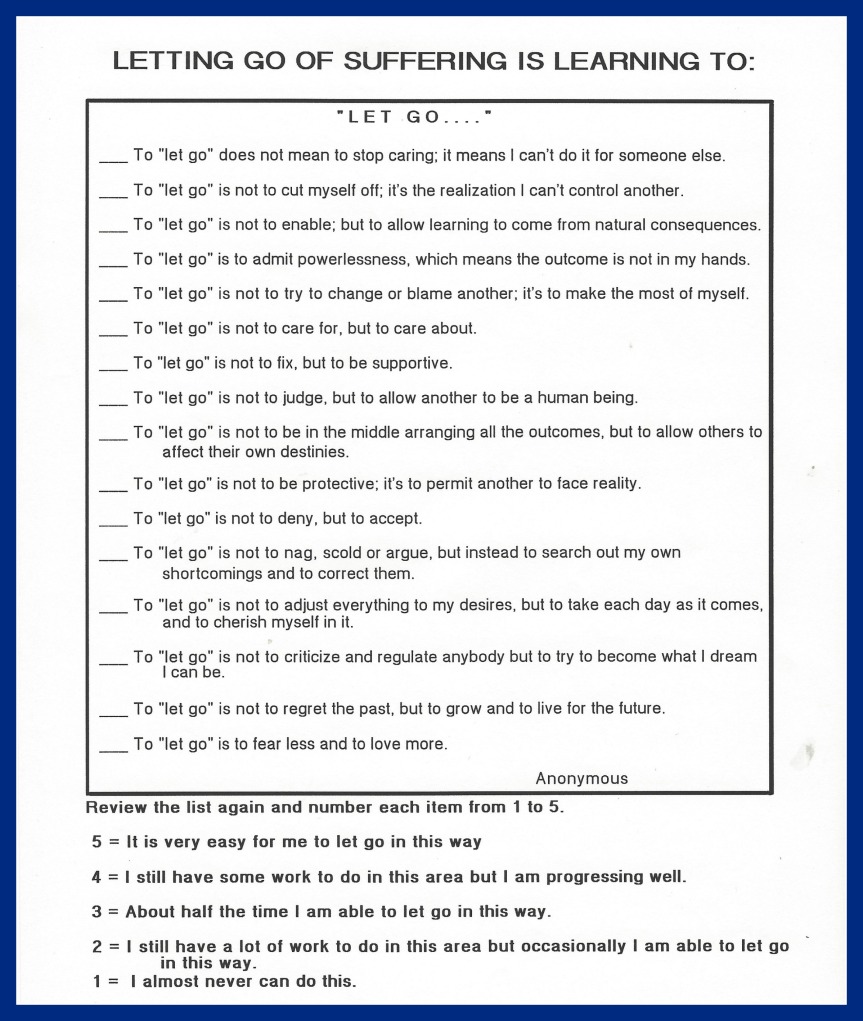
Letting Go of Suffering: Week 2- The Beginning Continued

Exercise 1:

An important step in letting go of suffering is identifying the many ways we contribute to our suffering. I make myself suffer when I eat too much chocolate, when I agree to do things I don’t want to do, and when I over-think or over-do. What are the unhealthy behaviors  you do that bring suffering into your life?

chains

Exercise 2

In the psychotherapy model I use, therapists differentiate between core feelings and racket feelings. Child words, i.e. mad, sad, scared and glad, are used to designate the core feelings. Rackets are substitute emotions that are used to cover (hide) the core-level feelings.  Racket feelings are much more likely to lead to suffering than experiencing and addressing the core feelings.

In our families of origin, some emotions might have been more acceptable than others. In my family it was okay to feel scared but not mad, so I learned to cover my mad with scare. The pattern became so pervasive in my life that there was a period of time when I needed to assume that I was mad whenever I felt scared. When I examined my scare, I usually discovered there was no danger present and that I was actually mad. So in this example, scare was the racket and mad was the core. Other people may cover their scare with mad.

While core feelings can become rackets, there are also many other kinds of racket feelings. Some common examples are disappointment, confusion, sarcasm, and guilt. Using the chart below, identify the racket feelings that you use as substitute emotions. If you identify any that are not on the chart, add them. This week, whenever you experience a racket feeling, see if you can identify the core feeling that lies underneath it.

racket

Exercise 3

The more we can learn about our own suffering tendencies, the easier it will be to stay out of them. For example, if we tend to be miserable on holidays, then it is important to be proactive in making plans for those days, ones that will give us satisfaction and prevent suffering. In the chart below, identify factors that are part of your suffering profile. If you become aware of other factors during the week, or in the future, add them.

profile


See you next Monday for the third lesson.

To find the lessons in this series that have already been published click here.


Letting Go of Suffering: Week 1- The Beginning

You are probably reading this post because you have a desire to let go of your suffering. This course will consist of 17 lessons, each containing concepts or tools that can aid you in your endeavor. The content is based on a workbook I wrote in 1991. I will be posting a new lesson each Monday.

Suffering, as used in this course, is defined as “extended hurt.” It is “the persistence of painful feelings long after they were provoked.” (Judy Tatelbaum)  Letting go of suffering does not mean living a life void of challenges or pain; it means not getting stuck in the pain

People often think of suffering as being prolonged sadness. It can also be prolonged anger or fear. There is likely to be some degree of suffering present whenever we are holding on to the past or worrying about the future.

Suffering is also brought on by the unhealthy behaviors we do in the present, those behaviors that make us miserable.

Be gentle with yourself as you go through the course.  Let this be an opportunity for you to experience being successful without expecting yourself to be perfect.

During the first two weeks, you will be gathering information about yourself. You will also learn more about suffering and about letting go. As you complete the exercises, either print the post and write your answers directly on the exercise sheets, or just write your answers in a notebook.

Exercise 1

When you are suffering, it is often important to get help from others as you work to shift the energy. In the boxes below, or in your journal or notebook, write the names and phone numbers of people in your life who might be available when you need support.

support-2

Exercise 2

What scares you about letting go of your suffering? Write down any fears that come to your mind, whether they make sense to you or not.

fear2

Exercise 3

letgo2

For the rest of this week, reflect on your answers to these three exercises. Consider journaling about the thoughts, feelings and/or insights that surface as you do that.


See you next Monday for the second lesson.

To find the lessons in this series that have already been published click here.

Taize: Veni Sancte Spiritus

vidireras-698098_1280

This has been such a difficult week for me, as it has been for many of us. It seems like so much of what I hold dear is in danger.

From time to time during the last two days, a song from a monastery in France has come to my mind. That song is Veni Sancte Spiritus.

The Taize monastery is dedicated to the reunification of the Christian church. At this point there are 100 brothers living there. They come from various Catholic and Protestant denominations and are from 30 different countries.

Taize music touched me to the core the first time I heard it and that has never changed. I visited the French monastery with friends in 2003 or 2004. We had the privilege of spending part of one evening with Brother Roger, their founder. He was in his late 80’s at the time of our visit.

I will never forget that experience. I felt like I was in the presence of a master. One or two years later, he was murdered in the temple. The world lost a great soul that night, but his work lives on.

There are Catholic and Protestant churches singing Taize music all over the world. Those services are always ecumenical.

I have picked a version of Veni Sante Spiritus that includes several different languages (I don’t know how many languages since I only understand English!) When I started the video and the music began, I burst into tears once again.

Following the first video, there will be another one that is in English. And at the end of the post you will find the lyrics in English. The photos in the first video are from the Taize monastery.

I chose to put the video prior to the lyrics so you had an opportunity to get a sense of the song without knowing what it meant. Here is the English version followed by the lyrics. It is also a very beautiful version. As I am listening to it my tears are still pouring.

Lyrics

Come, Holy Spirit, from heaven shine forth with your glorious light.
Veni Sancte Spiritus

Come, Father of the poor, come, generous Spirit, come,
light of our hearts.
Veni Sancte Spiritus

Come from the four winds, O Spirit, come breath of God;
disperse the shadows over us, renew and
strengthen your people.
Veni Sancte Spiritus

Most kindly warming light! Enter the inmost depths of our hearts,
for we are faithful to you.
Without your presence we have nothing worthy, nothing pure.
Veni Sancte Spiritus

You are only comforter, Peace of the soul.
In the heat you shade us; in our labour you refresh us,
and in trouble you are our strength.
Veni Sancte Spiritus

On all who put their trust in you and receive you in faith,
shower all your gifts.
Grant that they may grow in you and persevere to the end.
Give them lasting joy!
Veni Sancte Spiritus

Read more: http://www.letssingit.com/taize-lyrics-veni-sancte-spiritus-t9tpw88#ixzz4PrsEY2x0
LetsSingIt – Your favorite Music Community


img_1345

Reclaiming the Right to Trust

hands-1201785_1280

I believe, at the core of every person, there is a part that is both trusting and trustworthy. Due to life’s traumas, however, that part may recede so deep inside that it may seem unreachable. In time, a person may even develop a belief system that says people are not to be trusted.

When people come from that framework, they are likely to see negativity, and even danger, coming from all sides. They don’t trust what others say, and look for ulterior motives. In time, they may become excessively independent. The thought of being interdependent may be unfathomable. The inability to trust often leads to anxiety and depression.

I have been a psychotherapist for almost 30 years. During those years, I have seen so many clients reclaim their right to trust. As they heal from the traumas of their past, they shift from the life stance that people are untrustworthy to an attitude that people are trustworthy unless proven otherwise.

That doesn’t mean that they start to trust without discrimination though. Once they work through their childhood and adult traumas, they stop projecting negative behaviors on everyone and will become much clearer in seeing the true “red flags” that indicate potential problems. They are more likely to surround themselves with a support system of healthy people. They will know their own weak areas and will avoid situations that are likely to pull them into unhealthy behaviors.

Reclaiming the right to trust is not an easy journey, but it is well worth the time and effort.

Written for Daily Prompt: Trust
Photo Credit: pixabay.com


Don’t Wait Until…

This post by my friend Arati makes an important point in an unusual way. Enjoy!

Arati's avatarDancing to the Words

To all the familiar voices expounding
I should
I have to
I gotta
I don’t have time
It’s gotta be done today
If I don’t no one else will
If I don’t do this it won’t happen…

Pause

Breathe

Watch a sunset or sunrise
through the branches of your favorite trees
or on the horizon beyond ocean
lake or desert
or reflected in the windows of tall buildings.

Have a cup of tea, herbal or black
decaf coffee, or enjoy the caffeine.
A glass of wine … or not.
Take a moment to sit
to stroll barefoot at the edge of the ocean
river or lake
in a meadow or city park.

Chill, as someone I love would say.

Don’t wait until ….

skeleton-in-pleasanton

View original post

“YOU PROMISED!”

When I hear someone use the word “promise” the psychotherapist inside of me goes on alert. The images that come to my mind are children who are in trouble saying “I promise I won’t do it again” to their parents, or parents saying “You promised you wouldn’t do that again” to their children. I also think of bickering children saying to each other, or even to their parents, “You promised!” when someone doesn’t follow through on a promise.

It is important that interactions between adults stay equal with the adult part of one interacting with the adult part of the other. Two adults interacting in a way where one is acting like a parent and the other like a child can be very disruptive to adult relationships.

I think when people of any age hear the word “promise” their minds often add the word “forever”. “Forever” doesn’t take into account that we have a right to change our minds. We may have committed to something out of fear or without having taken the time to think the situation through. Also circumstances may change. When circumstances change then our commitments may need to change.

That doesn’t mean we should just say “I will try.” I’ve been told that Alcoholic Anonymous has a saying that “Triers are liars.”  Too often when people say “I will try” they are saying it to get someone off their back and have no intention of doing what the other person is asking for. In my group room, I have a Yoda pillow that says “Do. Or do not. There is no try.”

I suggest people don’t make promises because to me that word in and of itself evokes a child or a parent-child response. I don’t think there is anything wrong with making commitments or agreements but it is important that those commitments be well thought out, clear and not come from an over-adaptive part of us. They should be made with an understanding that we aren’t going to be perfect and that if we decide at a later time that the commitment is not in our best interests we can look at what changes need to be made and re-negotiate it.

Post written for: Daily Prompt: Promises
Photo: Bickering Children by Bernhard Keil (1624-1687) via Wikimedia

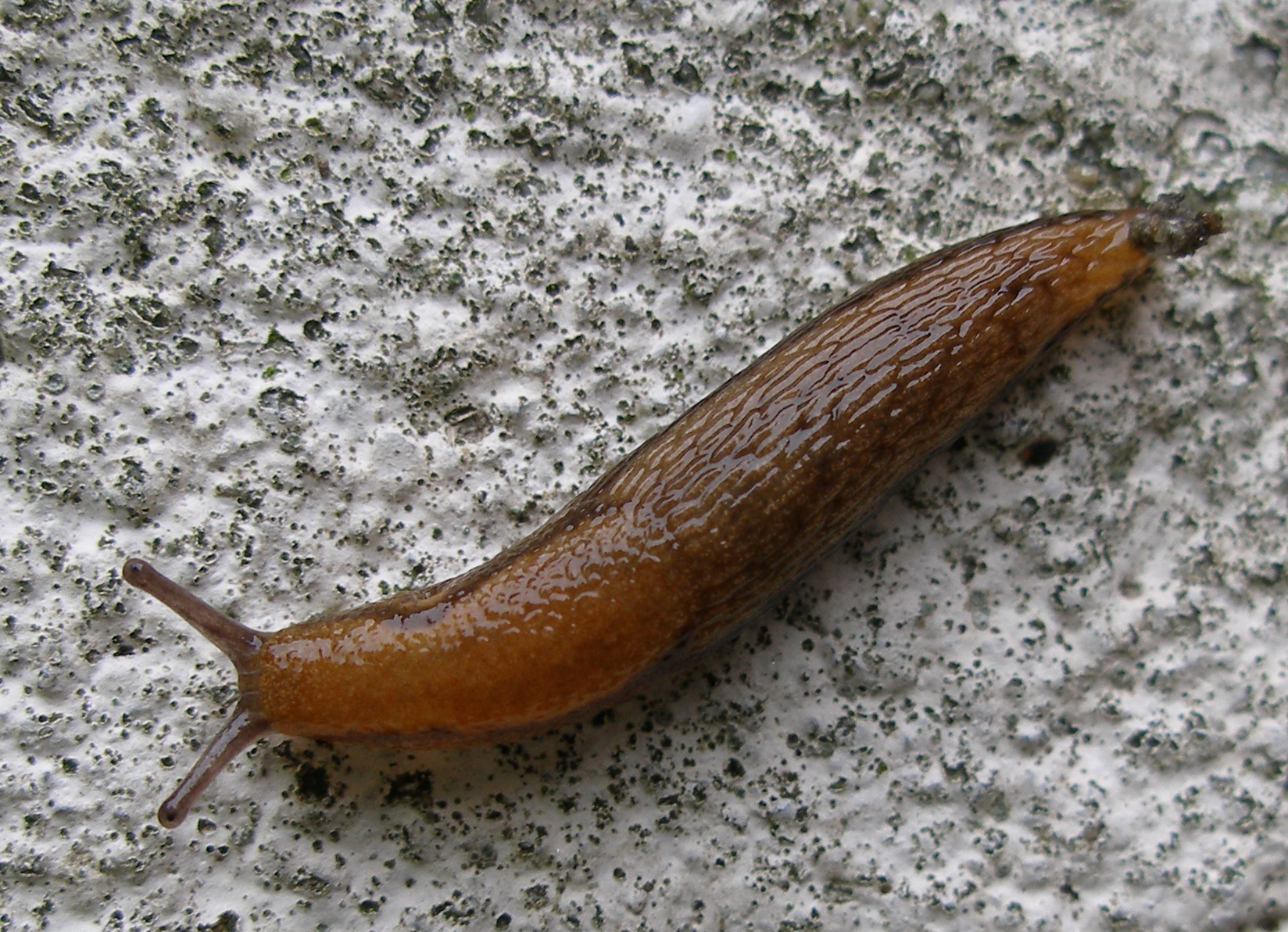
Seeking to Live in Harmony with Slugs

I have been reading a book by an urban farmer that I have been thoroughly enjoying, until last night. Just before I went to bed I read how she killed slugs in the most horrific way I can imagine. This morning I decided to re-read a post I wrote last year… and share it with you. (Be sure to also read the 2016 addendum.)

*******

2015 post

Photo Credit: Wikimedia

I imagine slugs are a problem for most gardeners, they sure have been for me. It is so discouraging to go to the garden in the morning and see only the stalks left on bean plants and other vegetable seedlings. In the “old” days I used to use powdered slug bait to get rid of them. Later on, I used beer to bait them.

I have become increasingly uncomfortable with killing the slugs. Early this year it seemed I had more than ever; especially in my two worm bins. Believe me, good compost and free food can raise some BIG slugs. During the early part of the summer, I relocated them to other parts of the yard and hoped they didn’t make their way back to my garden. Occasionally, when I found them in the worm bins, I just left them there.

Then one day I decided to see if there was any information on the internet about the relationship between worms and slugs. I was very dismayed to discover that slugs EAT worms! I even found videos that showed that happening.

Eating my vegetable starts was one thing, but getting plump from eating my worms was completely unacceptable. From then on I took the slugs to the bottom of the empty lot behind my house, about 250 feet away from my garden and my worm bins. That area is full of blackberries vines but I pulled up a lot of morning glory plants and made the slugs a soft bed of edibles.

Next year I will make a home for them that is more hospitable, but still far away from things I hold dear.

I will also experiment with other ways to protect my seedlings. For example, I like the gutter planters that my friend Saroja created this year. She didn’t put her seedlings into the garden until the plants were big enough to be of no interest to the slugs.

saroja

I am happy that I have found ways to protect my garden and worm bins without killing the slugs. I hope to be even more successful in that venture next year.  If you have found peaceful ways to deal with the slugs in your garden, I would love to hear about them!

****

I found the information in the following articles very interesting:
Fascinating Slug Facts
Slimy Summer Invasion
Earthworms protect against slugs

*********

2016 Addendum: What I have found interesting this is year is that I have not needed to follow through on my 2015 plan. Other than losing two green bean seedlings at the beginning of the season, I have had NO problem with slugs in my garden or yard this year. There have been a few in my worm bins, and they were big and fat before they came into view, but I have just set them free outside of the worm bins. I don’t know where they go but I do know that all of the plants in my yard have been spared!

Just before hitting publish on this current post, I decided to read the article I mentioned above “Earthworms protect against slugs.” It reported about a study that showed that slugs damage 60% less leaves if earthworms are present. I know my yard has more earthworms than ever before so maybe that is the reason I’ve had no problem this year. I don’t know the “why”, but I definitely appreciate the reprieve and hope it continues.

You Are Enough Right Now

img_3054


“You are enough right now, not after further, future achievements, but now, as you are.

Your wisdom is a valuable contribution to others right now, not after further study and life experience, but now, as it is.

You are worthy of respect and compassion right now, as you are, and not just because Brene Brown says so, but she does say so, and she seems like a nice person.

You are wonderfully lovable as you are right now, not at some future point when you’ve purged yourself of every human foible, but now, and not just because Mr. Rogers would say so, but you know he SO would.

You have the inalienable right to be flawed, ordinary, in your stuff, and off-track. These are fundamental to existence, and in no way subtract from any of the above.

Go forth and rock.”

by Fritz Reitz
Quote used with permission

Am I Contributing to My Living or My Dying?

img_3308

In 1996, I was on an airplane that “fell” 25,000 feet in about a minute’s time. For the next two hours we did not know if we were going to live or die. Since then I have had a sense that I am living on borrowed time. I think I was supposed to die that day, but Grace prevailed. Now, I see every moment I live as a gift and remember that tomorrow is not promised. I have a strong desire to live in a way that allows me to die without regrets.

When I was a new psychotherapist, I assisted in a therapy group led by Delphine Bowers.  She used to ask clients if the actions they were thinking about doing would “contribute to their living or their dying.”  That question has stuck with me for almost 30 years.

***

I believe I am contributing to my dying, instead of my living, when I am:

Overdoing

I am great at getting things done. There was a time in my life when I was working three jobs, going to school, and raising two children. Throughout my adult life, I have generally been unwilling to stop “doing” unless I get so sick that I can’t do otherwise.

In the last few years, I have made great strides in stopping that behavior. Still, it is not lost on me that I have back problems which have impacted my level of activity since mid-February. While 97% of the time I am resting and doing what I know I should do,  I still find myself saying, “Oh it’s okay if I plant a few seedlings.” Or I do other minor garden work when I know I should be avoiding all leaning over and bending down. What will it take for me to learn this lesson?  I shudder to think of the answer.

Overthinking

I used to obsess about anything I wanted to say for so long that I often lost the opportunity to say it. I also obsessed about things I did say, analyzing my words looking for errors or wondering if I had said something that made me look stupid. While I stopped those behaviors decades ago, I believe that overthinking is still the most common way I make myself miserable. And it is certainly the source of most of my stress. If I am offended by something, I may fixate on it. Worrying about the future also leads me to overthinking. The fact that I avoid mind-slowing spiritual practices, such as meditation, perpetuates the problem.

***

I have long been aware of my tendency to overdo and overthink. In fact I have written about those behaviors before. (Recovering from Overdoing, Stay in the Present and Stop Thinking!) In the last month, awareness of another way I contribute to my dying has resurfaced.

Emotions such as anger, sadness and fear are meant to show us that there are problems we need to deal with. If we feel the feelings and address the issues, the emotions are likely to flow through us. If we repress them, we probably won’t solve the problems and we may become depressed, anxious or sick.

I have been conscious of the fear in my body for a long time, but I used to bury my anger so deep that I didn’t even realize it was there. Now I feel the anger at the time it is triggered. My new awareness is that I am repressing my grief.

***

Stuffing Grief

When I was growing up, a frequent message from my father was, “If you are going to cry, I will give you something to cry about.”  If I didn’t stop crying, I was usually spanked or sent to my bedroom.  I learned it was not okay for me to express my sadness.

When I met Amma in 1989, grief began to erupt from inside of me. Generally that grief was not associated with any conscious memory. Even though I didn’t know what it was related to, I often had a sense that I was releasing the energy from traumas that had occurred earlier in my life. Sometimes I wondered if some of it was coming from other lifetimes, or if it was some form of “universal grief.” That spontaneous release of tears, which usually occurred during Amma’s programs, went on for several years.  Letting them pour out felt very healing.

Then one day someone teased me about my tears. My childhood programming took over and I shut them down so fast it was mind-boggling. From time to time, something will still bring up that deep well of grief inside of me, but for the most part it is nowhere to be found.

A week or so ago, there was a moment when I felt sadness about my back pain and the resulting physical limitations. I shed a tear, or maybe two, before a firm inner voice said, “It’s good that you felt your sadness, but that is ENOUGH.” I saw that my father’s message was still operating within me. Certainly no healing can come from releasing one or two tears.

When I heard the news that Prince had died, I started crying, and I cried on and off throughout the week.  The grief I felt was so deep, very similar to the level of emotion I experienced during my early years with Amma. While Prince’s “Purple Rain” album and movie, and especially the song “When Doves Cry,” was important to me in the 80’s, I hadn’t followed his career after that, other than taking my children to his 1988 Seattle concert.  Even though I didn’t understand my level of emotion, I was aware that the tears I shed felt cleansing and therapeutic.

***

I believe that overdoing, overthinking and stuffing my grief are the three biggest ways that I am currently contributing to my dying.  I know it is important for me to continue working on these issues and to keep the “Will this action contribute to your living or your dying?” question in mind as I make day-to-day decisions as well as when I consider long term decisions, such as when to retire.

I have no way of knowing whether I will live one more day or one year, five years, ten years or more.  I am committed to making the most of every moment I have left in this lifetime.


Originally Published on May 6, 2016 as part of  The Seeker’s Dungeon’s On Living and Dying event.

If you’d like to be one of the guest authors, you can learn more about the event here: 365 Days On Living and Dying.


Hide

Faith Eirans posted this profound and intimate look into her life and into her being on The Seeker’s Dungeon this morning. I thought it was an important post for me to share so am sending it your way.